
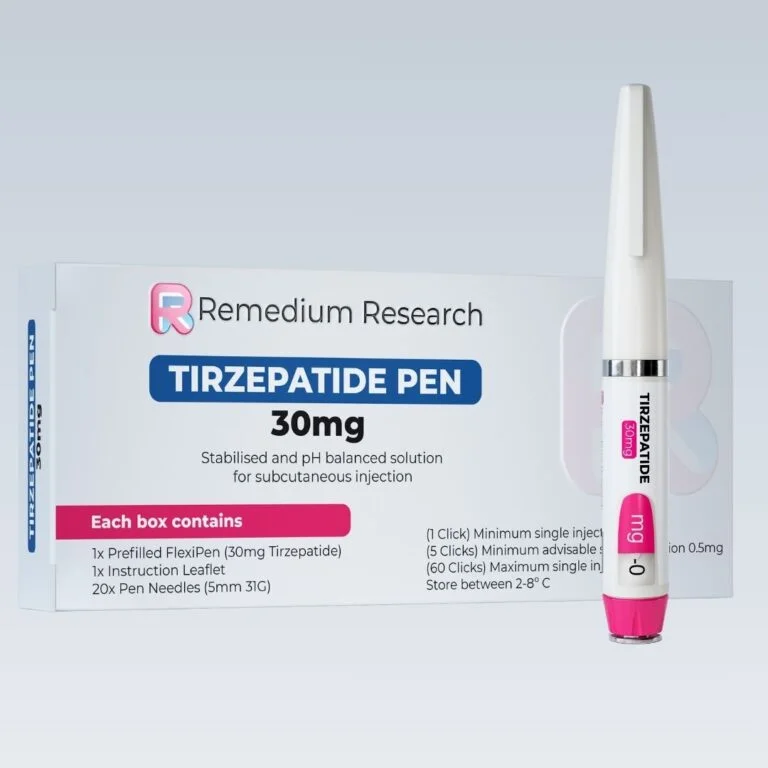
Remedium Research Tirzepatide 30mg
£105.00
Evaluating Incretin Dual-Agonism: Remedium Research Tirzepatide 30mg
The landscape of metabolic and endocrinological science is undergoing a profound transformation. Moving beyond isolated receptor targeting, contemporary biological research is heavily focused on the synergistic potential of multi-receptor incretin mimetics. For principal investigators requiring high-yield, stable compounds for longitudinal in vitro or animal model studies, Remedium Research Tirzepatide 30mg stands as a premier investigational asset.
This high-capacity lyophilized peptide provides laboratories with a substantial volume of material, essential for executing comprehensive dose-escalation protocols, continuous receptor exposure assays, and complex pharmacokinetic mapping without the disruption of frequently changing experimental batches.
The Molecular Mechanism of Remedium Research Tirzepatide 30mg
Unlike earlier generations of single-target peptides, this synthetic derivative is specifically engineered as a dual-agonist, targeting both the Glucose-Dependent Insulinotropic Polypeptide (GIP) and Glucagon-Like Peptide-1 (GLP-1) receptors.
Structurally, the peptide chain is modified with a specialized C20 fatty diacid moiety. This critical addition allows the molecule to bind heavily to albumin once introduced into biological models, radically extending its clearance rate and mimicking the sustained exposure necessary to evaluate chronic metabolic shifts. Researchers mapping these intricate structural modifications frequently refer to molecular pathology databases maintained by the National Center for Biotechnology Information (NCBI).
GIP Receptor Dominance in Remedium Research Tirzepatide 30mg
One of the most fascinating aspects of this compound for laboratory analysis is its “imbalanced” or “biased” agonism. While it binds to both incretin targets, Remedium Research Tirzepatide 30mg exhibits a much higher affinity for the GIP receptor—comparable to native human GIP—while acting as a biased partial agonist at the GLP-1 receptor.
This specific balance is hypothesized to prevent the rapid desensitization of the GLP-1 receptor, a common limitation observed in older single-agonist therapies. By prioritizing the GIP pathway, this peptide triggers unique intracellular cascades that aggressively upregulate lipid metabolism and enhance insulin sensitivity in white adipose tissue.
Laboratory Benchmarks for Remedium Research Tirzepatide 30mg
When defining the parameters for in vitro and in vivo testing, scientists often map their dosing models against established clinical benchmarks. The extensive data derived from the global SURPASS clinical trial programs provides an excellent foundational reference for expected metabolic outcomes.
During these trials, the dual-agonist approach demonstrated unprecedented efficacy in simultaneously lowering HbA1c levels and driving significant body mass reduction. Laboratories examining the comparative efficacy of dual-agonists versus GLP-1 monotherapies routinely study trial methodologies cataloged extensively on ClinicalTrials.gov.
By integrating Remedium Research Tirzepatide 30mg into targeted cellular assays, researchers can isolate these dual-pathway interactions, evaluating exactly how GIP co-activation mitigates the cellular stress often associated with high-dose GLP-1 exposure.
Designing Assays with Remedium Research Tirzepatide 30mg
The versatile nature of this 30mg presentation allows for a wide breadth of experimental designs. Because it profoundly impacts energy regulation, it is heavily utilized in:
-
Adipocyte Culturing: To measure the upregulation of adiponectin, a critical hormone involved in fatty acid breakdown and glucose regulation.
-
Pancreatic Beta-Cell Assays: To monitor glucose-dependent insulin secretion rates and beta-cell survival under metabolic stress.
-
Hepatic Steatosis Models: Evaluating the reduction of lipid accumulation and generalized inflammation in liver cells.
Researchers publishing novel findings on these exact lipid-lowering mechanisms frequently submit their rigorously peer-reviewed data to high-impact biological journals such as The Lancet Diabetes & Endocrinology.
High-Yield Stability and Preparation Protocols
Handling high-concentration, research-grade peptides requires uncompromising precision to maintain the integrity of the delicate amino acid sequence. The lyophilized formulation must be stored in a deep-freeze environment (ideal at -20°C).
Upon initiation of an experiment, investigators should carefully reconstitute Remedium Research Tirzepatide 30mg using only sterile bacteriostatic water or a biologically appropriate buffer solution. The introduction of the solvent must be gradual, followed by gentle swirling rather than aggressive agitation, which can fracture the peptide bonds. Once mixed, the active solution must be partitioned into proper experimental aliquots, refrigerated at 2°C to 8°C, and shielded entirely from ambient light exposure to prevent rapid molecular degradation.
Research Compliance Notice: This product is strictly distributed as a laboratory research chemical. It is explicitly synthesized for controlled in vitro applications and authorized animal studies. It is not approved by regulatory agencies for human consumption, nor is it a therapeutic medication. All handling must adhere strictly to established institutional biosafety guidelines.
Be the first to review “Remedium Research Tirzepatide 30mg”
Related products



Reviews
There are no reviews yet.